


Shipper | Case study 5 min. read
How proactive logistics cut costs for a global paper company

Executive summary
For a global paper and forest products company operating in complex, capacity-constrained markets, transportation could not be managed as a series of short-term transactions. The company needed a more strategic way to control costs, stabilize service and build reliable capacity across a geographically challenging network. Schneider helped the customer achieve results by moving to a more proactive logistics approach built around visibility, network planning and strong carrier relationships.
Key takeaways
- Centralized visibility and proactive network planning help shippers control costs, strengthen capacity and make more informed transportation decisions.
- Collaborative, long-term carrier relationships can create more reliable capacity and cost stability across challenging freight markets.
- Flexible mode and equipment strategies can unlock measurable savings while improving efficiency across complex transportation networks.
Background
The customer is a global paper and forest products company with high-volume shipping needs across North America. Its products are heavy, its transportation network is complex and many of its facilities are located outside major freight markets. That combination made capacity planning, cost control and service consistency critical to the company’s broader supply chain performance.
Schneider began working with this shipper in the mid-2000s, initially providing truckload capacity. As the customer expanded its North American footprint, it needed a provider that could bring more structure, visibility and strategic guidance to its transportation network.
Over time, Schneider’s role expanded from transportation execution to broader supply chain support. Through a Transportation Management System solution, Supply Chain and Distribution Management helped centralize mill-level data, improve carrier tendering consistency and provide greater visibility into cost, capacity and network performance.
Challenge
The customer’s transportation challenge was not caused by a single disruption. It stemmed from growth, network complexity and the limitations of managing transportation through disconnected, mill-level processes. Before Schneider began supporting the customer with supply chain management services, the organization’s internal teams relied heavily on spreadsheets, phone calls and localized decision-making to manage freight movement.
That approach made it difficult to see performance across the full network. Without a centralized view of cost, capacity and routing guide performance, the company had less visibility into where its transportation network was strong, where it was exposed and where long-term opportunities existed. Schneider’s first North American network bid helped reveal those gaps by showing where carrier coverage, pricing and capacity were concentrated — and where they were limited.
Geography made the challenge more urgent. Two major shipping locations with significant volume were outside traditional freight markets, where carrier capacity is harder to access. These facilities required a deliberate strategy to support consistent capacity, reliable service and cost stability.
Solution
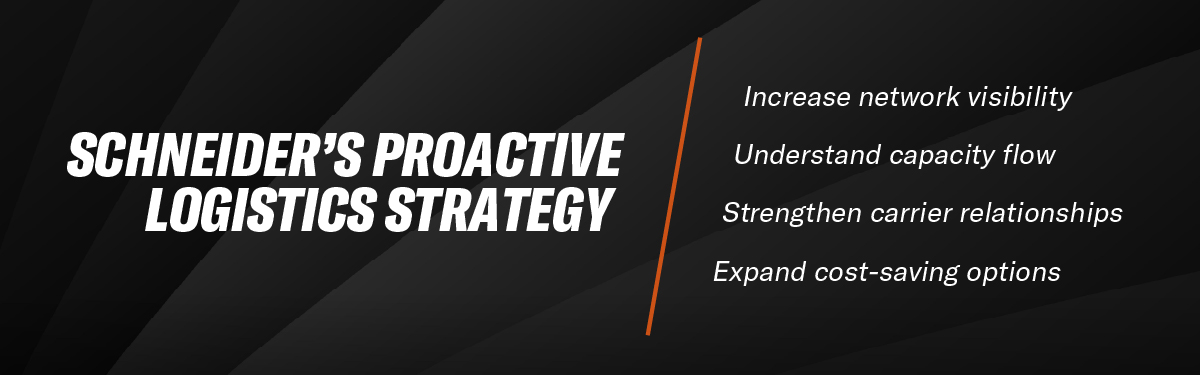
The customer's transportation challenges could not be solved by simply adding more carriers or renegotiating rates. Schneider worked collaboratively with the customer to create a proactive logistics strategy designed to improve capacity access, stabilize costs and support long-term growth.
Creating greater visibility across the network
The first step was helping the customer move beyond mill-level transportation management.
- Implemented a Transportation Management System solution that centralized transportation data across facilities
- Replaced fragmented processes and spreadsheets with a more unified view of transportation activity
- Improved visibility into costs, carrier performance and network opportunities across North America
- Provided reporting and market intelligence to support more informed transportation decisions
Understanding how capacity moves through the network
Many of the customer's facilities were in markets that did not naturally attract large pools of truck capacity. Rather than reacting to capacity shortages as they occurred, Schneider analyzed how carriers entered those regions and built strategies around those freight flows.
- Studied inbound and outbound freight patterns in markets
- Identified opportunities to align outbound freight with destinations carriers already needed to serve
- Reduced inefficient empty miles and improved equipment utilization
- Created stronger incentives for carriers to continue serving challenging markets
Building strategic carrier relationships
Instead of pursuing the lowest available rate whenever market conditions changed, Schneider helped the customer focus on long-term transportation performance.
- Developed a core carrier strategy built around consistency and mutual value
- Conducted regular network reviews and bid events to balance pricing, capacity and routing guide performance
- Worked with carriers to align rates with market conditions while preserving access to dependable capacity
- Maintained consistent freight opportunities during slower market periods to help ensure carriers remained committed when conditions tightened
Expanding transportation options to reduce costs
As the relationship evolved, Schneider continuously evaluated opportunities to improve efficiency throughout the network.
- Identified lanes where Intermodal service could reduce costs while supporting operational goals
- Worked with supply chain and sales stakeholders to improve planning processes and mode selection
- Used benchmarking tools, purchasing expertise and market intelligence to uncover additional savings opportunities
- Developed specialized solutions, including a tri-axle transportation strategy for Canadian shipments, to improve payload efficiency, reduce transportation costs and lower emissions per ton by moving more product per trip
Schneider supported the customer with a broader mix of service offerings as the relationship evolved. What began as truckload support grew to include Dedicated, Intermodal, Brokerage and Schneider Supply Chain and Distribution Management. This flexibility allowed Schneider to recommend solutions based on the customer’s changing network needs rather than forcing the freight into a one-size-fits-all model.
Results
Delivering measurable transportation value
Over the past 12 months, Schneider delivered $5.7 million in cost mitigation and savings through projects and process improvements. Schneider has managed the customer's supply chain for nearly 18 years, continually identifying opportunities to improve cost, efficiency and performance.
Maintaining competitive costs through market volatility
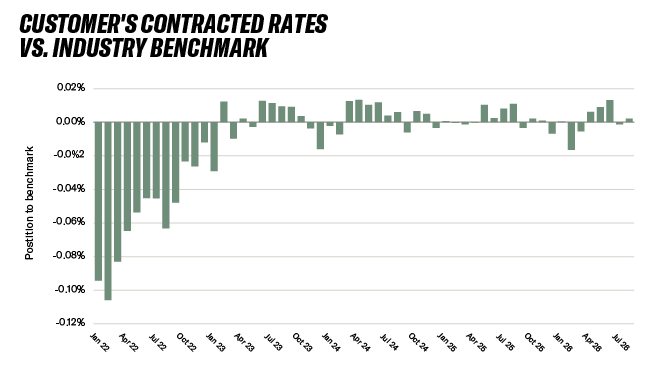
Between January 2022 and August 2026, the customer’s contracted load costs ranged from 10.6% below benchmark to 1.3% above benchmark. Even as freight market conditions shifted, the customer maintained an overall contract cost position approximately $4.1 million below benchmark, demonstrating the value of a proactive procurement strategy.
Reducing costs through a tri-axle strategy
Today, more than 96% of truckload shipments into Canada move on tri-axle trailers, enabling significantly greater payload efficiency. Over the past 12 months, the strategy delivered $2.4 million in transportation savings, with an average cost per ton of $83.49 compared to $154.92 for tandem shipments.
Building long-term capacity stability
Schneider's strategic carrier approach helped create a more stable transportation network. While many shippers struggle with tightening capacity and rising costs, the customer continues to maintain strong carrier engagement and has achieved 140% of carrier commitments, reflecting the strength of its long-term network strategy and carrier relationships.
Why it matters
Proactive and strategic logistics management turns transportation into a business advantage.
For shippers under pressure to protect margins, the lowest rate is rarely the full answer. Short-term savings can disappear quickly when capacity tightens, service suffers or spot-market decisions create new exposure. The stronger approach is to treat transportation as a strategic function, one that balances cost, service, risk and network efficiency over time.
This customer’s experience shows how that shift can work. By moving from fragmented, transactional transportation management to proactive logistics, the company gained better visibility, stronger carrier relationships and more control over transportation costs. Schneider helped turn a complex freight network into a more predictable source of performance. The result is a transportation strategy built to perform when markets are soft, when capacity tightens and when business needs change.
Boost efficiency with multimodal transportation
Explore how Schneider’s proactive logistics approach and flexible multimodal service offerings can help you build stronger carrier relationships, improve cost control and create more reliable transportation performance across your supply chain.
Related resources
Drive your business forward
Sign up to receive our industry leading newsletter with case studies and insights you can put to use for your business.